
Around the world, violent conflicts and mass displacement have upended the education of an entire generation. Globally, 224 million children in crisis-affected areas now urgently need educational support, including over 72 million who are out of school entirely. War and insecurity force schools to close, families to flee, and children to put learning on hold. In Sudan alone, the eruption of conflict in 2023 shut down every school in the country, leaving an estimated 19 million children, about one in three of all Sudanese children, out of school. “Sudan is on the brink of becoming home to the worst education crisis in the world,” UNICEF’s Sudan representative warned. Even before the war, nearly 7 million Sudanese children were already out of school due to poverty and instability. Now the fighting has escalated Sudan’s education emergency to the largest in the world, a status echoed by UN officials in 2025.
Conflict’s toll on education is staggering. Schools are often damaged or destroyed, for example, in Ukraine one in seven schools has been impacted by the war, with over 3,500 schools affected and nearly 400 reduced to rubble. Classrooms in war zones may be occupied by armed groups or repurposed for shelters and camps, depriving children of safe learning spaces. Teachers are frequently displaced or unpaid, and educational resources become scarce. Prolonged disruptions mean that even when children remain nominally enrolled, their learning suffers: over two-thirds of crisis-affected students who do attend school do not achieve minimum proficiency in reading or math. Many youth lose hope of ever catching up. If these educational gaps persist, experts project that 825 million young people could lack essential skills by 2030 due to missed schooling in crises. Yet education is more than a casual casualty of war, it is widely seen as essential to protect and empower children amid chaos. As one humanitarian expert put it, “Education is lifesaving. It’s a dual-purpose solution that protects vulnerable children in the short term and ignites their long-term capacity to contribute to their communities.” In other words, getting kids back to learning is both an urgent humanitarian need and a long-term investment in peace and recovery.
Unfortunately, education in emergencies remains chronically underfunded, comprising less than 3% of global humanitarian aid, even as needs are at an all-time high. Nonetheless, across conflict-affected regions, communities and organizations are striving to move “from crisis to classroom” by re-opening schools, establishing alternative learning spaces, and deploying innovative solutions to ensure children can continue their education. The following sections highlight best practices for restoring learning in war-torn contexts, from creating safe schools to leveraging education in emergencies technology, and how these approaches are being combined to re-engage younger students in particular.
Re-Opening Schools Safely in War-Torn Regions
Reopening schools after or even during conflict is a delicate but critical task. The first priority is safety. Aid agencies stress that where security permits, classrooms should be made safe and functional again as soon as possible, and where areas remain unsafe, learning must shift to alternative modes. In Sudan, for instance, UNICEF and Save the Children have urged authorities to reopen schools in stable areas while supporting alternative community-based learning for children in regions too dangerous for formal schooling. This might mean setting up temporary learning centers in displacement camps, using local buildings as improvised schools, or organizing small group classes in safer villages. In conflicts such as Syria and South Sudan, tents and makeshift classrooms have often been used to reach displaced children until permanent schools can be rebuilt. In Ukraine, some communities have even established “underground schools” in basements and metro stations to keep children learning during air raids. Blended learning arrangements are common – in Ukraine today, about 1 million children (out of 4 million school kids) are studying entirely online due to war disruptions, while others follow a mix of in-person and remote classes. The key is flexibility: schooling may resume in shifts, in new locations, or via radio/TV broadcasts if needed, until normalcy returns.
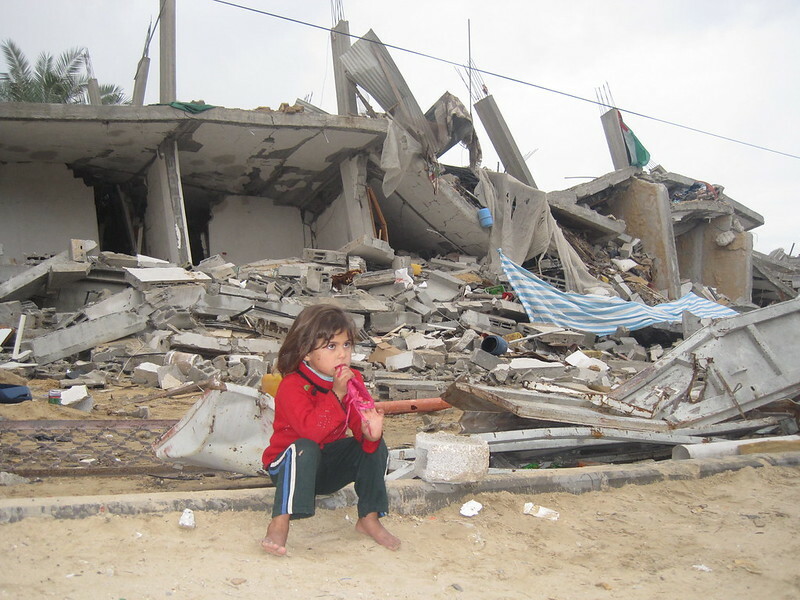
“Gaza war Nov2012” by EU Civil Protection and Humanitarian Aid, CC BY-NC-ND 2.0
Alongside physical safety, psychosocial support and normalcy are crucial elements of school recovery. Going back to class represents stability and hope for conflict-affected kids. Education experts describe schools as a “lifeline” for children living through trauma. Within the classroom, children regain daily routine, peer interaction, and a sense of belonging that helps mitigate the toxic stress of war. Schools often also deliver life-saving services, for example, nutrition programs, basic healthcare, and counseling, which may have been interrupted during the crisis. Simply put, re-opening a school can anchor an entire community’s recovery. “My happiest moment is going to work, playing with the children and teaching them,” says Fatima, a displaced teacher in a conflict-hit region of Nigeria, underlining how passionate local educators are vital to bringing kids back to learning.
However, reopening schools is not as simple as unlocking doors. Conflict devastates the education infrastructure and workforce. In many cases teachers have gone months or years without pay, and government education budgets are in free fall. In Sudan’s crisis, most teachers have not received salaries since fighting began, and thousands of schools lack basic supplies or maintenance. International support is needed to repair buildings, replace furniture and textbooks, and get teachers back on the payroll. Community involvement is equally important: engaging parents, elders, and local leaders helps assure families that schools are safe and that education is valued even amid hardship. Where formal systems are shattered, community volunteers might step in as learning facilitators with some training. Crucially, initiatives must be conflict-sensitive and culturally appropriate, so that education promotes peace and healing rather than exacerbating tensions. This can include adapting curricula to avoid biased content, teaching tolerance and socio-emotional skills, and ensuring all ethnic or refugee groups have equal access to learning. In summary, “safe schools” in conflict zones require not only physical protection, but also nurturing environments and strong support for teachers and students alike. By focusing on safety, psychosocial well-being, and local engagement, war-affected communities can begin to rebuild an education system even before the guns fall silent.
Catch-Up Learning and Blended Learning Solutions
For children who have missed out on months or years of schooling, simply reopening the school gates is not enough, they need opportunities to catch up to their appropriate learning level. Many young students in these contexts have fallen far behind in basic literacy and numeracy, or even forgotten skills they once learned, due to prolonged interruptions. Best practices in education recovery therefore emphasize accelerated learning programs and targeted remedial support to bridge learning gaps. For example, in Syria UNICEF implemented a “Curriculum B” accelerated program that combines two academic years into one, allowing children who were out of school to fill learning gaps in half the time and rejoin formal education at a level appropriate for their age. Students in Aleppo enrolled in this program were able to complete multiple grade levels in one year with the help of trained teachers, catching up with their peers despite years of disruption. Similar accelerated education initiatives, often covering primary curriculum in a condensed format, have been used in countries from Nigeria to Yemen to give out-of-school youth a “second chance” at education. Key elements include age-appropriate content, a focus on foundational skills, and flexible schedules (since many conflict-affected children may also be working or carrying family responsibilities). Bridging courses and remedial classes can also help children transition back into regular schools: for instance, a displaced child returning home might take an intensive language or math course over summer to prepare for the new school year. These “catch-up” programs are essential to ensure that war-affected students are not left permanently behind their peers.

Blended learning, integrating digital learning support with traditional teaching, has emerged as a powerful strategy in crisis settings to enhance and extend educational reach. During the West Africa Ebola epidemic and in conflict zones, radio education programs demonstrated how technology can fill the void when schools close. Educational radio broadcasts, and more recently TV and mobile phone lessons, have helped deliver lessons to children in remote or lockdown situations. In conflict-affected Syria, for example, radio and online content were used to broadcast curriculum lessons to students sheltering at home. Today, new digital tools go beyond one-way broadcasts: interactive software, tablets, and smartphone apps enable children to continue learning even if they cannot attend class, often at their own pace. Studies indicate that EdTech has significant potential to help children keep learning during emergencies, from conflicts to pandemics. Notably, tablet-based learning games have shown promise – one programme in Sudan provided solar-powered tablets with a mathematics game to out-of-school children, and results showed they learned math faster and better using the tablet-based approach than through traditional classes. The tablets tracked each child’s progress and adjusted to their level, illustrating the power of personalized, self-paced learning for catch-up.
Indeed, self-directed digital learning can complement teacher-led instruction in crises. Experts recommend a combination of methods: “Blended approaches, promoting interactions with teachers and peers, and self-directed approaches, allowing greater autonomy, each have the potential to promote positive learning outcomes for children in emergencies.” In practice, this means children might spend part of their day in a group class or with a tutor, and another part using adaptive learning software or offline worksheets to practice skills individually. Such blended learning keeps students connected to educators and friends (important for motivation and well-being) while also letting them progress at their own speed to fill gaps. Importantly, teachers and facilitators must be trained and supported to use technology effectively, otherwise, introducing unfamiliar EdTech in a crisis can overwhelm staff already under stress. But when done right, technology can actually reduce teacher workload (through automated exercises and tracking) and empower instructors with better data. For instance, digital tools can collect data on students’ progress even in remote settings, enabling education coordinators to monitor how well children are learning and identify those needing extra help. This real-time data is incredibly valuable in emergency education responses, where adjusting quickly can save a child from dropping out.
A major consideration for EdTech in conflict zones is connectivity. Internet and electricity may be unreliable or non-existent in many affected areas. Thus, the most effective digital learning solutions are those that offer offline access and low-bandwidth usage. Humanitarian researchers emphasize providing offline learning resources and adaptable digital platforms that can work without continuous internet. This could mean pre-loading content on tablets or smartphones, using SD cards or USB drives to distribute lessons, and designing apps that sync only occasionally when a connection is available. For example, some educational apps allow teachers to download all the modules while in town and then use them offline in a village classroom with no internet. Others use local servers or intranet setups at community centers to host content without needing global connectivity. Power sources like solar chargers are also employed to keep devices running in the absence of grid electricity. By optimizing for offline, mobile use, EdTech can truly reach children “anytime, anywhere” – whether they are in a refugee camp, a remote rural settlement, or an urban bunker hiding from shelling. Digital content must also be curated to be culturally relevant and available in local languages for meaningful impact. When these factors are addressed, technology becomes a lifeline for learners: not only delivering academic content, but also providing a sense of continuity and hope. Research even suggests that engaging with interactive learning technology during crises can support children’s psychosocial well-being, keeping them connected to peers and boosting their confidence and engagement. In summary, a blend of catch-up programs, community engagement, and smart use of technology forms the backbone of learning recovery in conflict situations. These approaches meet children where they are, academically and geographically, to help them reclaim their right to education.
Innovative Tools for Recovery: The Case of AHS Education
As schools and organizations work to integrate the above best practices, new innovative tools are emerging to support education in emergencies. One compelling example is AHS Education (AHSEdu.org) – a nonprofit FREE learning platform designed to provide “Education Without Boundaries” for young learners, including those in difficult environments. AHS offers a full Grades 1–5 curriculum via an interactive online and offline-capable platform, making it well-suited for recovery and catch-up learning in fragile contexts. Here are some key features that align with the needs of conflict-affected students and teachers:
• Interactive, Engaging Lessons: AHS delivers a fun, cartoon-based curriculum with short animated video lessons followed by quizzes and practice questions. The content covers all core subjects (math, literacy, science, social studies, etc.) and is standards-aligned to ensure quality. Crucially, the lessons are interactive and game-like, which helps recapture children’s attention after long interruptions. Studies show that such interactive learning can dramatically boost knowledge retention – students retain far more from engaging, multimedia lessons than from passive lectures. By making learning feel like play, AHS keeps children motivated and rebuilding their skills. Each lesson is bite-sized to accommodate shorter attention spans and can be repeated as needed, allowing self-paced learning for students who have fallen behind. “It keeps kids motivated and excited to learn,” noted one parent about the gamified format, a critical advantage in post-crisis settings where many learners struggle with concentration or confidence.
• Offline Access Anywhere: Because connectivity is often a luxury in conflict zones, AHS is built to work both online and offline. The platform supports offline learning, meaning lessons and exercises can be downloaded using a flash-drive provided by the organization and then used without a live connection. Students in remote or displaced communities can thus continue their education even with no internet. Additionally, AHS provides printable worksheets and materials for every topic, so educators or parents can print practice exercises for children who prefer paper or lack devices. This dual online/offline design is vital in emergency education – it ensures that the lack of Wi-Fi or electricity is not a barrier to learning. Whether in a refugee camp tent or a rural village, AHS’s content can be accessed anytime, anywhere.
• Comprehensive Curriculum & Catch-Up Support: With a full interactive curriculum spanning early grades 1 through 5, AHS allows children to either follow a normal grade progression or revisit earlier grade material to fill gaps. This is ideal for catch-up learning: for example, an 11-year-old who missed school for two years can work through the Grade 3 and 4 modules at an accelerated pace to reach grade-level proficiency. Because the curriculum is organized by skill (and aligned to clear standards), students can focus on specific areas (like basic reading or arithmetic) where they are behind. The platform’s use of adaptive quizzes and feedback means each child can master prerequisites before moving on. By meeting learners where they are academically, AHS enables a personalized recovery journey – much like an accelerated learning program, but tailored to the individual. All core subjects are included, so students receive a well-rounded education even if their local school’s offerings are limited.
• Dashboards and Progress Tracking: AHS is not only student-friendly, but also offers robust tools for teachers, tutors, and parents to monitor and guide learning. Each student has a personal dashboard showing their lesson progress, badges earned, and quiz scores. Educators and parents can access detailed reports highlighting the child’s strengths, weaknesses, and mastery of each skill. This data-driven insight is invaluable in crisis contexts: teachers with large, mixed-ability classes can quickly see which students need extra help on which topics, enabling targeted remediation. Likewise, NGO program managers can use the data to evaluate the overall learning outcomes of children in a community program. The dashboards build accountability and motivation too, students see their own progress and gain a sense of accomplishment, which helps restore confidence after long absences from school. For parents in displaced or refugee families, AHS provides reassurance that their child is catching up. As one feature, automatic progress reports can be emailed or shown to caregivers, a function even many traditional schools lack. In sum, the platform’s monitoring tools help recreate the guided support that young learners need, even if they are studying under unconventional circumstances.
• Flexibility for Blended Learning: AHS Education was designed for flexibility, which aligns perfectly with the blended learning approaches needed in emergencies. The platform can be used in a variety of settings, by a teacher in a classroom with a projector or offline laptop, by students at home or in a shelter on a mobile device, or by tutors during small group sessions. It supports both online and in-person usage: lessons can be done remotely via the app or the website, or projected in a classroom and combined with group activities. Worksheets can be printed for hands-on practice or homework when digital access is limited. This means AHS can plug into hybrid models like part-time school, home-school, or community learning centers. Notably, AHS is offered by a nonprofit and provides a free trial, with low-cost licensing thereafter, and even scholarships for those in need. This affordability is crucial for NGOs or impoverished school systems recovering from crisis, they can deploy AHS without straining budgets, essentially gaining a full curriculum and learning management system at minimal cost. By reducing the burden on teachers (with ready-made lesson plans, assessments, and automatic grading), the platform also helps address the severe teacher shortages common in post-conflict situations. One educator can oversee more students or multi-level classes with AHS as an assistant. In places where qualified teachers are scarce, less experienced facilitators can lean on AHS structured content to ensure quality lessons. The user-friendly design means even teachers with limited tech experience can navigate the system after some basic training – an important factor when introducing EdTech in traumatized communities.
In summary, AHS Education exemplifies how blended, offline-capable learning platforms can accelerate education recovery in conflict-affected regions. Its interactive lessons re-engage children who have lost the learning habit, its offline mode breaks through connectivity barriers, and its comprehensive curriculum and tracking equip both learners and educators to pursue measurable progress. By leveraging such innovations, humanitarian programs and schools can integrate digital learning support into their toolkits for rebuilding education. The goal, as AHS motto suggests, is truly education without boundaries – reaching children wherever conflict or displacement has taken them, and providing them the chance to learn, catch up, and thrive.
The challenges of restoring education after crises are enormous, but the successes to date show a way forward. With safe classrooms, dedicated teachers, community support, and smart use of technology, even the most fragile contexts can help children go from the trauma of crisis to the hope of the classroom. For the millions of young students whose schooling has been derailed by war, these efforts are nothing short of lifesaving. And for organizations on the ground, tools like AHS Education offer a practical and impactful means to deliver learning and empower the next generation, so that no matter the circumstances of their early years, these children can build a brighter future through the power of education.
Learn more about what AHS has to offer to schools, nonprofits, parents, and tutors at NO COST: AHSEdu.org/about-ahs