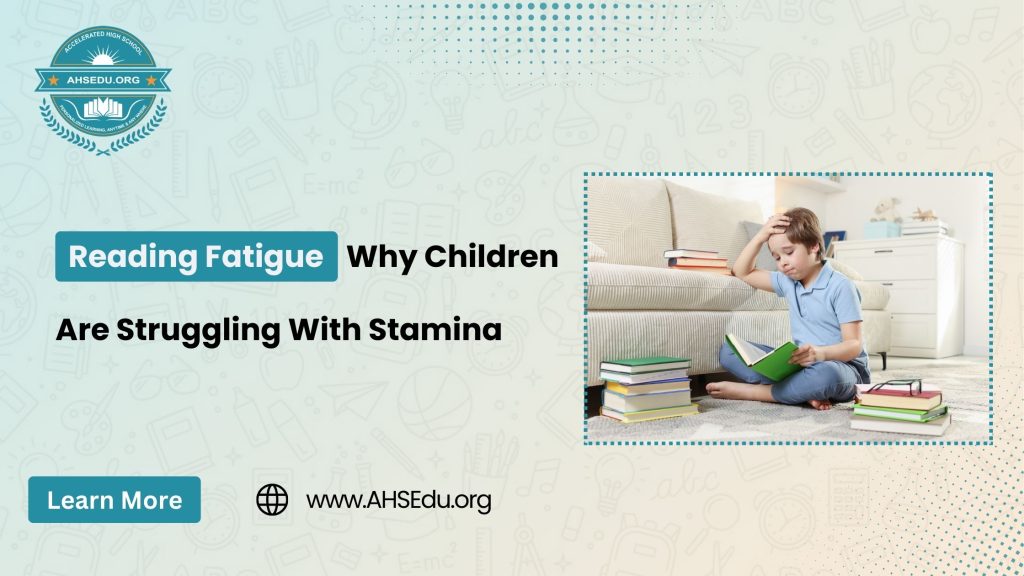
Across classrooms worldwide, teachers are sounding the alarm: early elementary students are struggling to stay focused while reading. Many can decode short words but lose concentration almost immediately. They skip lines, forget details, or disengage within minutes. Reading stamina, the ability to sustain attention and comprehension over time, has become one of the most urgent literacy challenges for Grades 1–5 in 2025.
UNESCO’s 2025 literacy update reinforces what educators observe daily. Globally, children are showing reductions in the amount of time they can sustain reading tasks, along with lower comprehension accuracy. The problem is especially prevalent in students whose early learning years were disrupted during the pandemic. These students, often called the “interrupted learners cohort,” received inconsistent early literacy instruction and now show higher levels of reading fatigue.
The Science Behind Reading Stamina

To understand reading fatigue, it helps to see stamina as a form of cognitive endurance. For a child to read continuously, the brain must perform several demanding tasks at once, decoding, tracking text, holding information in working memory, and connecting meaning. For young learners, this mental load can be overwhelming, especially when attention systems are still developing.
Neuroscientists emphasize that the brain regions responsible for focus and executive functioning mature gradually throughout early childhood. In Grades 1–5, children are still learning how to manage distractions, stay engaged during quiet tasks, and regulate their attention. When these developing systems are exposed to overstimulation or inconsistent learning routines, stamina quickly declines.
This is especially relevant in the post-pandemic world. Children now spend more time consuming fast-paced digital content than ever before. Quick, high-stimulation videos and apps train the brain to expect constant novelty, making slow, linear tasks like reading feel less rewarding. At the same time, disruptions in early schooling reduced the consistent practice necessary to build fluency and stamina. Many students simply did not receive enough steady, structured reading exposure during the years when those skills are most fragile.
Why Post-Pandemic Cohorts Are Struggling More
Students currently in Grades 1–5 were between ages 2 and 7 during the height of global school disruptions. These are the years when most children learn phonics, develop vocabulary, and begin reading independently. The pandemic interrupted these foundational stages. As a result, many children learned to decode but missed critical time spent on sustained reading practice. Now, teachers report a pattern where students can “read the words” but cannot maintain focus long enough to understand or remember what they read.
Another significant factor is the modern home environment. Many families face busy schedules, shared spaces, and increased background noise from devices and work-from-home routines. Quiet time, an essential condition for early reading development, is less available than it used to be. When children attempt to read in noisy or unpredictable environments, concentration becomes far more difficult, and stamina deteriorates.
The Role of Digital Overstimulation

One of the most impactful factors in reading fatigue is the dramatic increase in digital overstimulation. Children today consume content designed to deliver quick gratification: bright visuals, rapid transitions, and instant feedback. Compared to the pace of TikTok-style videos or fast-moving games, reading can feel slow or even boring.
The human brain adapts quickly to its environment. When children are regularly exposed to high-intensity digital media, their baseline for stimulation rises. Tasks that require quiet focus and deep processing feel more challenging by comparison. This helps explain why many early-grade students are more easily distracted, lose their place, or become frustrated during reading activities that previously would have held their attention longer.
What Families Can Do at Home
Despite the challenges, the path forward is extremely hopeful. Reading stamina can be strengthened with the right routines. Families don’t need long, complicated reading sessions. Instead, research shows that short, consistent, predictable habits make the greatest difference.
One of the most effective strategies is establishing daily read-aloud time. When parents read to children, they expose them to fluent reading, advanced vocabulary, and more complex sentence structures, all without placing extra cognitive strain on the child. This builds comprehension and engagement naturally.
Paired reading, where the parent and child take turns reading, is another powerful method. It reduces fatigue by sharing the reading load while helping the child stay focused and confident. Other successful strategies include “reading sprints”—very short bursts of focused reading followed by breaks—visual tracking tools like reading rulers, and comprehension games that make reading feel less like a chore.
What Classrooms Are Doing to Help
Teachers who are successfully improving reading stamina often use structured methods that build endurance slowly and steadily. Many classrooms use stamina charts, allowing students to track and celebrate their progress over time. Others use chunked reading, breaking texts into manageable sections that students can process without becoming overwhelmed.
Leveled reading practice also helps children build stamina at an appropriate difficulty level. When text is too hard, stamina drops quickly. When it’s too easy, students disengage. Finding the right balance keeps motivation and endurance high. Blended learning, combining teacher-led instruction with short digital lessons, also helps students stay engaged by offering variety and opportunities to reset attention.
How AHS Helps Reduce Reading Fatigue
AHS Education offers tools that align naturally with how young learners build stamina. One of the platform’s major strengths is its short, clear video lessons, which introduce reading skills in manageable segments. These lessons reduce cognitive overload and prepare students for longer reading tasks.
AHS also provides leveled reading passages and guided reading worksheets that help students practice comprehension step-by-step. Because the content is structured and predictable, children feel less overwhelmed and more confident. Short practice bursts built into the platform support stamina-building while keeping lessons engaging.
Another advantage is AHS’s offline learning mode. For children who need a quiet, screen-free or distraction-free environment, offline lessons offer a calm setting ideal for focused reading. Parents and teachers can track improvements using the dashboard, which shows where stamina improves and where focus weakens. This visibility helps adults intervene early and support targeted practice.
Conclusion
Reading fatigue is one of the defining literacy challenges of 2025, especially for students in Grades 1–5. But with consistent routines, structured practice, and supportive tools, children can rebuild stamina, comprehension, and confidence. The solution is not more pressure, it’s better support.
AHS Education helps families and schools provide that support through leveled reading materials, guided practice, short instructional videos, offline access, and clear progress insights. With the right tools and strategies, every child can regain the endurance needed to become a strong, motivated reader.
To begin supporting early-grade readers today:
Parents → https://ahsedu.org/demo-for-parents
Schools → https://ahsedu.org/demo-for-institute
Nonprofits → https://ahsedu.org/demo-for-nonprofit
Tutors → https://ahsedu.org/demo-for-tutor